A More Responsible Way to Experience India’s Tiger Country
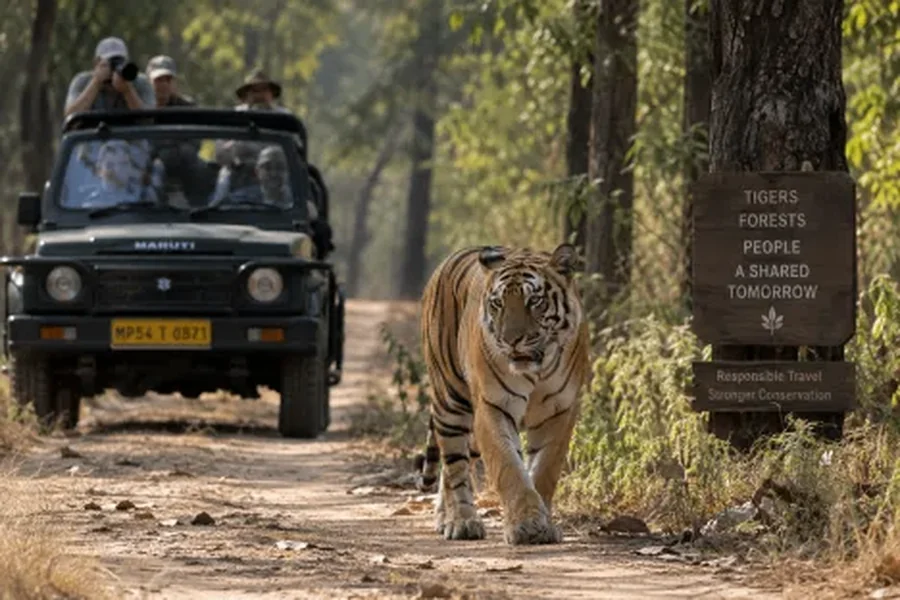
One of the most memorable experiences in India during traveling is seeing a Bengal tiger in the wild.
However, a wildlife adventure does not just end there where you can spot a tiger. It may also be of decelerating, getting to know a forest, assuring the local communities and educating how tourism may not be incompatible with a safeguarded landscape.
To the travellers who are becoming more concerned about meaningful and responsible travel, how a safari is organised is equally important as the location visited.
India has dozens of tiger reserves, each of which has a different landscape, animals and populations. The first step in the thoughtful exploration of the forest is to select the appropriate location, to allocate sufficient time and approach the forest with realistic prospects.
Choose the experience, not only the tiger
It is not hard to arrange a safari based on the following question: where can one see a tiger best? As a matter of fact, that is too easy of a question.
Wild animals are free to move, they are never sure of sightseeing and the nature of every reserve is varied.
The dry forest and the ancient topography at Ranthambore provide a totally contrasting experience as compared to the grass and rivers at Jim Corbett. Kanha has extensive meadows and Sal forests whereas Bandhavgarh provides another unique Central Indian tiger habitat.
In the Terai region of northern India, Dudhwa provides wetlands, grasslands and the likelihood of observing more one-horned rhinoceros and tiger habitat.
The correct place thus is not only based on the chances of seeing a tiger.
Travellers need to look at the season, number of safaris, length of the journey, interests in photography as well as whether the traveller wants to incorporate wildlife as well as cultural tourism sites like Delhi, Agra, Jaipur or Taj Mahal.
A carefully designed tiger safari tour should be built around these priorities rather than simply trying to fit as many parks as possible into one holiday.
Slow travel works particularly well in the forest Wildlife travel naturally rewards patience.
Changing hotels every night may work for a fast-paced city itinerary, but safari travel is different.
Spending three or four nights near one reserve gives travellers the opportunity to experience the same landscape at different times of day. Morning light may reveal fresh animal tracks, while an afternoon safari can be shaped by heat, water sources and changing wildlife movement.
Staying longer also reduces unnecessary transfers.
Instead of seeing the forest as another stop on a checklist, travellers have time to begin understanding it.
They may recognise the alarm call of a deer, notice how langurs react to a predator nearby or spend time watching birds and smaller animals that would otherwise be overlooked.
Sometimes the most memorable part of a safari is not a tiger at all.
Look beyond the headline species
The Bengal tiger may be the reason many travellers first consider an Indian safari, but healthy tiger habitat supports entire ecosystems.
Depending on the reserve, a safari may also bring encounters with elephants, leopards, deer, primates, crocodilians and a wide variety of birds.
Jim Corbett, for example, combines tiger habitat with elephants, rivers, grasslands and exceptional bird diversity.
Dudhwa provides an opportunity to experience Terai forests and grasslands together with rhinos, swamp deer and wetland birdlife.
Birdwatchers can also incorporate places such as Keoladeo National Park at Bharatpur into an India itinerary.
Looking beyond the tiger creates a more realistic and rewarding relationship with wildlife travel. It also reduces the pressure to judge every game drive by whether a big cat appeared.
Respect the forest’s rules
Responsible wildlife tourism depends on respecting the regulations of protected areas.
National parks restrict vehicle numbers, define tourism zones and control safari timings for a reason.
Travellers should avoid encouraging drivers to chase wildlife, crowd animals or ignore park regulations for the sake of a photograph.
Noise also matters.
A safari vehicle does not need to become a mobile viewing platform filled with constant conversation. Some of the most interesting moments happen when everyone remains quiet enough to hear what is happening around them.
Photography should follow the same principle.
Getting a photograph should never be more important than giving an animal space.
A distant tiger behaving naturally can provide a far more meaningful wildlife experience than a stressed animal surrounded by vehicles.
Local knowledge makes a difference
Naturalists, guides, drivers and people residing near the area of protection usually have years of experience in their working forests.
It is not merely a matter of finding animals that a good naturalist does.
They read songs, calls, behaviour, changes in habitat and seasons.
They may transform a silent safari experience into a learning process by telling them why the deer are resting their eyes on a certain direction, why birds behave in a certain way towards their predators or why the scenery adapts with the season.
Selection of specialist local services also retains more tourism value in association with the places travellers have gone to be.
In organisations like Jungle Revives, this kind of field experience plays a crucial role in organizing wildlife trips especially to foreign travellers who might be new to wildlife safari permits, regions of reserves and travel distances in India.
Simple experiences as a component of luxury traveling A hotel, private transfer and amenity can be the attributes that define luxury travel in the modern day. Another definition can be given to wildlife.
Travellers will be allowed to stay in Forest Rest Houses within certain areas of the reserve, which is in Jim Corbett but will require the granting of a permit and is subject to availability.
These accommodations might be basic than luxury resorts outside the wood, but its worth is in another place.
A traveller has fallen asleep in the reserve.
The surrounding landscape rather than the hotel becomes the main experience. It might have less distractions, less connectivity and more time listening to the forest.
That simplicity can be one of the most memorable aspects of the trip to travellers who are seeking to escape continuous monitors and time watching.
Combine wildlife and culture thoughtfully
Responsible travel does not entail a trade off between wildlife and cultural tourism. It is possible to have both in India.
A first-time traveller can join Delhi, Agra and Jaipur with Ranthambore, which will form a journey that comprises both the Taj Mahal and the habitat of tigers.
More time will be available to visit Corbett, Dudhwa or the Central Indian reserves. It is not crucial to cram the itinerary.
The excessive destinations lead to more time on the road or on the airport and less meaningful time at every destination.
Fewer destinations traveled more slowly will offer more fulfilling experiences, and will consume less needless movement.
A safari should leave more than photographs
Wildlife tourism is best explained as the form of tourism where the travellers end up going home with more than a set of pictures of tigers.
The experience has the potential to foster a more comprehensive understanding of why forests are important, the complexity of wildlife habitats and why conserved landscapes require conservation and responsible tourism.
The sighting of a tiger can be just a couple of minutes.
Nevertheless, the time that is spent searching tracks, listening to the forest, watching birds and learning about the landscape are what make that sighting worth so much.
It is, perhaps, the most responsible manner of travelling in the tiger country of India: come curious, go slow, get acquainted with the forest and leave the game to dictate your pace.