1960s Fashion: A Guide to the Decade’s Most Iconic Styles

Few decades changed clothing as quickly as the 1960s. The period opened with ladylike suits, gloves and carefully set hair, and closed with bare feet, bell-bottoms and fringed suede. In between came the miniskirt, space-age tailoring and a youth market that, for the first time, told the fashion industry what to make rather than the other way round.
There is no single look that sums up 1960s fashion. It is better understood as three overlapping phases, each with its own silhouettes, fabrics and heroes.
The Early Sixties: Polish and Restraint
The first years of the decade were essentially a continuation of the late 1950s. Women’s daywear centered on tailored skirt suits, sheath dresses and neat coats, finished with gloves, pumps and a structured handbag. Hair was set and backcombed into bouffants, and hats were still part of a complete outfit.
Jacqueline Kennedy became the most-copied woman of this phase. Her wardrobe as First Lady, much of it designed by Oleg Cassini, favored clean lines, boxy jackets with oversized buttons, sleeveless shift dresses and the pillbox hat. It was conservative in structure but noticeably simpler than the full-skirted New Look styles of the previous decade, and that simplification pointed the way forward.
Menswear was similarly buttoned up: narrow-lapel suits, slim ties, white shirts and short, neat hair were the norm for office life.
Swinging London and the Mod Look
By the middle of the decade the center of gravity had shifted to London, where young designers and shop owners were dressing a generation with its own money to spend. Boutiques on King’s Road and Carnaby Street sold inexpensive, fast-changing clothes aimed squarely at teenagers and people in their twenties.
Mary Quant, whose Bazaar boutique on King’s Road predated the decade, became the name most associated with the miniskirt. Hemlines crept above the knee and kept rising, and the short skirt became the defining symbol of the era’s youth culture. Barbara Hulanicki’s Biba offered a moodier, more romantic take at prices young women could afford.
The mod look was graphic and precise. Its key elements included:
- Shift and A-line dresses that skimmed the body rather than shaping it, often in bold color blocks or black and white.
- Geometric and Op Art prints such as checks, stripes, circles and chevrons.
- Flat shoes and low boots, including white ankle and mid-calf boots, which suited the shorter hemlines.
- Opaque and patterned tights, which made the miniskirt practical.
- Sharp hair, from Vidal Sassoon’s precision geometric cuts to the cropped pixie worn by the model Twiggy.
Makeup shifted focus to the eyes: pale lips, heavy liner, false lashes and sometimes lashes drawn onto the lower lid.
Space-Age Fashion
While London was busy with youth fashion, several Paris designers looked to the future. André Courrèges showed crisp white and silver trouser suits, short dresses and flat white boots in the mid-1960s. Pierre Cardin experimented with helmet-like hats, cut-out shapes and stiff, sculptural fabrics. Paco Rabanne went further still, constructing dresses from linked plastic and metal discs.
The space-age look relied on new materials as much as new shapes. PVC, vinyl and synthetic jerseys gave clothes a glossy, modern finish, and white and metallic silver became fashion colors in their own right. Many of these pieces were impractical for daily life, but their influence filtered into high-street shift dresses, shiny raincoats and go-go boots.
Menswear: The Peacock Revolution
Men’s clothing loosened up dramatically during the decade. Mods wore slim, sharply tailored suits with short jackets and narrow trousers, often with a parka over the top for riding scooters. Carnaby Street became known for bright shirts, patterned ties, hipster trousers and velvet jackets.
Musicians accelerated the change. The Beatles’ early collarless suits and later psychedelic military-style jackets were widely imitated, and longer hair gradually became acceptable for young men. Turtlenecks worn in place of shirt and tie, Nehru-collar jackets and printed shirts all offered alternatives to conventional business dress. The press of the time labeled this burst of color and flamboyance in menswear the “Peacock Revolution.”
The Late Sixties: Counterculture and the Hippie Style
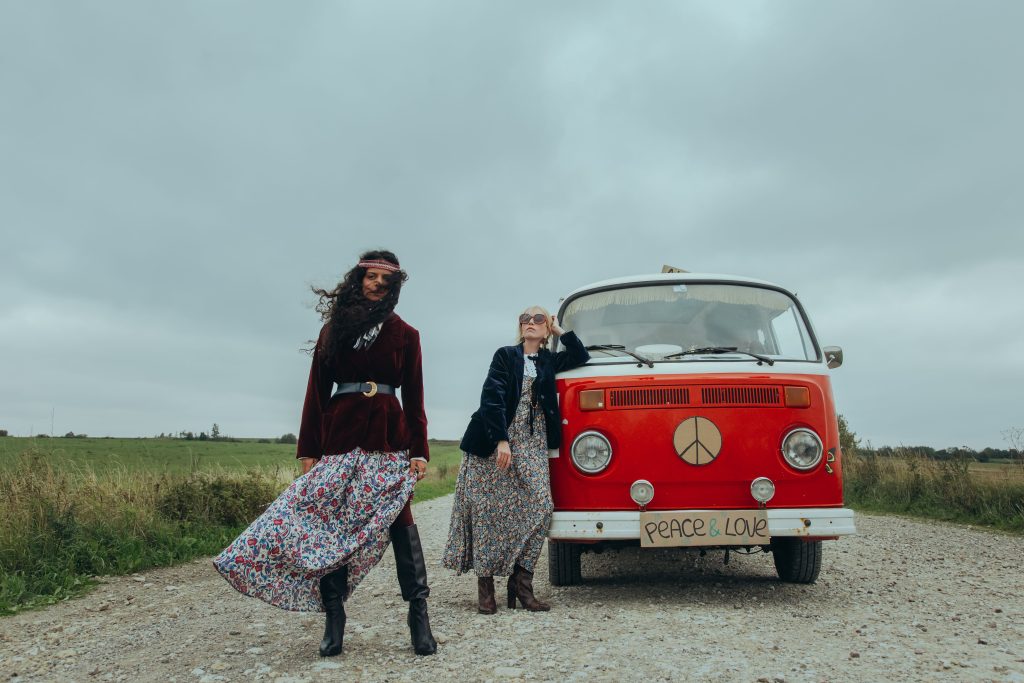
The final years of the decade moved away from mod’s hard edges. The counterculture that grew up around the civil rights and anti-war movements, psychedelic music and events such as the 1967 Summer of Love and the 1969 Woodstock festival favored clothes that looked handmade, secondhand or borrowed from other places and eras.
Typical pieces included flared jeans and bell-bottoms, peasant blouses, long floaty skirts and maxi dresses, fringed suede vests and jackets, embroidered and patchworked denim, kaftans, headbands and plenty of beads. Tie-dye, paisley and swirling psychedelic prints replaced crisp geometrics. Hair grew long and loose for both men and women, and makeup became more natural.
Designers followed the street. Hemlines began to drop again toward the end of the decade, with midi and maxi lengths setting up the more relaxed silhouettes of the 1970s.
Designers and Figures Who Shaped the Decade
Beyond the names already mentioned, a few others left a lasting mark:
- Yves Saint Laurent produced his Mondrian-inspired color-block shift dresses in 1965 and introduced Le Smoking, a tuxedo suit for women, in 1966.
- Emilio Pucci made his swirling, brightly colored prints on lightweight silk jersey into a status symbol.
- Rudi Gernreich in the United States pushed boundaries with body-conscious knits and provocative swimwear.
- Twiggy and Jean Shrimpton became the faces of the era’s slim, youthful ideal, helping define how the new clothes were photographed and worn.
How to Wear 1960s Style Today
The decade’s shapes translate well to a modern wardrobe as long as you borrow one idea at a time rather than recreating a full costume.
- Start with a shift or A-line dress. A simple, sleeveless shape in a solid color works for the office with a fine knit or for evenings with a bold earring.
- Pick one graphic element. A color-blocked top or a black-and-white geometric skirt reads as mod without the rest of the outfit needing to match.
- Adjust the hemline to suit you. A skirt just above the knee gives the feel of the era; opaque tights and a flat boot or loafer keep a shorter length practical.
- Try tailoring with a slim line. A short, narrow-lapel jacket or cropped trousers with loafers nods to mod menswear.
- For late-sixties style, pair flared jeans with a peasant blouse or a suede jacket, and keep accessories to one statement piece.
- Keep beauty focused. A defined upper lash line and a soft, pale lip is a wearable version of the classic mod eye.
Why the 1960s Still Matter
The decade’s most important legacy is not a single garment but a shift in power. Young people became the audience that designers and retailers followed, ready-to-wear gained ground on couture, and clothing became a way of signaling identity and politics as much as status. The miniskirt, the shift dress, the trouser suit for women and the relaxed, eclectic style of the counterculture all remain part of the fashion vocabulary, which is why designers return to the 1960s again and again.