1980s Fashion for Women: Iconic Trends That Defined the Decade
Women’s fashion in the 1980s was about presence. Shoulders widened, colors brightened, hair got bigger and clothes were designed to be seen. At the same time, the decade produced some very practical ideas, from the working wardrobe built around a suit to leggings as everyday wear.
The styles below cover the office, the gym, the dance floor and the red carpet, and many of them still shape what designers show today.

Power Dressing and Shoulder Pads
The defining look of 1980s fashion for women was the power suit. As more women moved into professional and management roles, a tailored jacket with strong, padded shoulders, paired with a knee-length skirt or trousers, became a kind of business uniform. The broad shoulder balanced the hips and created an inverted-triangle silhouette that read as authoritative.
Designers pushed the shape in different directions. Giorgio Armani offered softer, fluid tailoring in neutral tones, while Thierry Mugler and Claude Montana built dramatic, sculpted shoulders. Television and film spread the look widely: the costumes in Dynasty made big-shouldered glamour a mainstream aspiration, and Working Girl (1988) captured the office version.
Shoulder pads did not stay in suits. They appeared in blouses, dresses, knitwear and coats, often sewn in and sometimes attached with Velcro so they could be removed.
Donna Karan and the Modular Wardrobe
In 1985 Donna Karan launched her own label with “Seven Easy Pieces,” a capsule built around a bodysuit that could be combined with a skirt, trousers, jacket and other items to take a woman from day to evening. The idea of a small, interchangeable wardrobe for working women was influential, and the bodysuit became a key piece of the late 1980s.
Aerobics Style and Sportswear
The fitness boom changed everyday clothing. Jane Fonda’s workout videos, starting in 1982, helped make aerobics a mass pastime, and the outfits came with it: high-cut leotards, shiny Lycra leggings, leg warmers, sweatbands and aerobics sneakers such as Reebok’s Freestyle.
Much of this moved out of the studio. Leggings were worn with long sweaters and oversized T-shirts, and the cut-necked sweatshirt slipping off one shoulder became famous through Flashdance (1983). Norma Kamali, who had already made sweatshirt fleece into fashion, was among the designers who took casual jersey fabrics seriously.
Bold Color and Pattern
Subtlety was not the goal for much of the decade. Hot pink, electric blue, emerald, purple, yellow and neon shades were worn head to toe or clashed deliberately. Color-blocking, geometric prints, polka dots, abstract patterns and animal prints appeared on everything from blouses to swimwear.
Accessories were equally bright: plastic bangles, chunky earrings and colorful belts cinching an oversized top at the waist.
Denim
High-waisted jeans with a tapered leg were the dominant denim shape, usually worn with a tucked-in top and a belt. Acid-wash and stonewash finishes were hugely popular, as were denim jackets, denim skirts and even denim dresses. A slightly oversized denim jacket over a dress or leggings was a standard casual look.
Pop Star Style
Music television meant that pop stars set trends on a scale never seen before. Madonna’s early look, built from lace tops, layered crucifixes, rubber bracelets, fingerless gloves, tulle skirts and bows in the hair, was copied by teenagers everywhere. Cyndi Lauper’s thrift-shop mixing of colors, layers and bright hair offered a similar spirit of self-invention.
Street and club scenes contributed their own looks, from punk and goth to the New Romantics’ dramatic, historically inspired dress.
Romance and Excess in Eveningwear
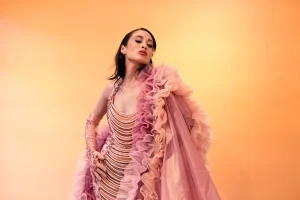
Evening fashion was opulent. Puffed sleeves, taffeta, ruffles, sequins and metallic lamé were common. The wedding dress Diana, Princess of Wales, wore in 1981, designed by David and Elizabeth Emanuel with huge puffed sleeves and a long train, influenced bridal fashion for years.
In Paris, Christian Lacroix’s puffball skirts brought a theatrical, voluminous shape to the late 1980s, while Azzedine Alaïa went the opposite way with body-conscious knits and precise seaming that hugged the figure. Both approaches, volume and body-con, coexisted throughout the decade.
The Counterpoint: Japanese Avant-Garde
Not everything was bright and glossy. When Rei Kawakubo of Comme des Garçons and Yohji Yamamoto showed in Paris in the early 1980s, their loose, asymmetric, predominantly black clothes challenged Western ideas of the flattering silhouette. Their influence on intellectual, minimalist fashion has proved just as lasting as power dressing.
Hair and Makeup
Volume defined 1980s hair: perms, teased crowns, side ponytails, crimping and fringes set high with hairspray. Scrunchies and oversized bows held it in place. Makeup was just as bold, with bright eyeshadow, strong blush applied toward the temples, defined brows and vivid pink or red lips.
How to Wear 1980s Style Today
Most of the decade’s ideas work well in a modern wardrobe when you pick one statement and keep the rest simple.
- A strong-shouldered blazer is the most useful piece. Wear it with straight jeans and a plain T-shirt, or with a slip skirt for contrast.
- High-waisted jeans with a tucked-in knit and a belt give the 80s shape without looking like fancy dress.
- One bright color, in a jacket, bag or shoe, reads as a nod to the decade; head-to-toe neon rarely does.
- A bodysuit makes a smooth base under tailored trousers or skirts.
- Leggings with an oversized sweater remain a comfortable off-duty outfit; swap leg warmers for a sleek boot.
- Beauty: choose either a bright lip or a colorful eye, and add volume to hair with a blow-dry rather than a full perm.
Proportion is the key. If the shoulders are wide, keep the lower half streamlined; if the top is oversized, show a little shape at the waist or legs. That balance is exactly what 1980s designers were playing with, and it is why the decade’s silhouettes keep returning to the runway.