How to Build a Sustainable Fashion Brand from Scratch Using On-Demand Printing

Starting a fashion brand does not require a factory contact, a warehouse, or a six-figure budget. That is the version of the story the industry has told for decades — and it has kept a lot of talented designers on the sidelines. The truth is that most of what makes traditional fashion so wasteful is not inevitable. It is just the result of a production model nobody bothered to question. Bulk orders, seasonal forecasting, minimum quantities — these were never laws of nature. They were defaults. And defaults can be changed.
On-demand printing has quietly dismantled most of the structural barriers that used to make independent fashion so risky. You design something, someone orders it, you print it and ship it. No inventory sitting in a storage unit. No guessing what will sell in six months. No end-of-season clearance problem. It is a cleaner model in every sense of the word — financially, operationally, and environmentally. Tools like the Huedrift Official Store have brought that kind of production within reach for independent creators who are serious about building something real.
Here is how to actually do it.
Step 1: Know What You Stand For Before You Design Anything
This sounds obvious. Most people skip it anyway.
Sustainable fashion buyers are not casual shoppers. They research brands, they read about materials, they notice when the story does not quite add up. If you cannot articulate clearly what your brand is, who it is for, and why it exists — beyond “I like clothes and care about the planet” — they will figure that out quickly.
Get specific about your audience. Not “women who care about sustainability” but something much narrower: women in their thirties who are done buying cheap things and replacing them every season. That specificity shapes everything — your design language, your price point, your tone of voice, where you show up online.
And decide what your non-negotiables are. Organic fabrics only? Transparent pricing? Made-to-order always? Pick your commitments before the operational pressure of running a business gives you reasons to compromise on them.
Step 2: Design With the Printing Process in Mind
DTF printing has real strengths, and the smartest on-demand brands design into those strengths rather than around them.
Full-color artwork, fine detail, gradient transitions, illustrative graphics — DTF handles all of it beautifully, at a level that vinyl cutting or basic embroidery cannot touch at the same price point. If your design sensibility leans toward bold, graphic, detail-rich work, you are already in the right territory.
Start smaller than feels comfortable. Three to five pieces that genuinely belong together will do more for your brand than a sprawling launch collection that confuses people. On-demand makes it easy to add things — let early customer response tell you what to expand rather than guessing upfront.
One practical note: every file should be 300 DPI minimum, saved as PNG with a transparent background. Clean files produce clean prints. This is not the place to cut corners.
Step 3: Find Blanks You Can Actually Stand Behind
The blank underneath the print is half your product — and in sustainable fashion, it is half your story.
DTF works well on cotton, linen blends, recycled textiles, and most natural fiber fabrics. That matters because sublimation printing — the other common on-demand method — is essentially limited to polyester, which cuts off most of the materials sustainable brands actually want to work with. With DTF, your fabric choices are driven by your values, not your equipment.
Look for GOTS-certified organic cotton, OEKO-TEX certified fabrics, or recycled content materials. These certifications exist specifically because “sustainable” as a marketing claim is easy to make and hard to verify — third-party certification does the verification for you, and your customers know the difference.
Build real relationships with your suppliers. Sustainable blanks vendors tend to be smaller and more communicative than commodity wholesalers, and they are generally much more willing to work with the low-minimum purchasing patterns that on-demand production creates.
Step 4: Choose the Right Printer for Where You Actually Are
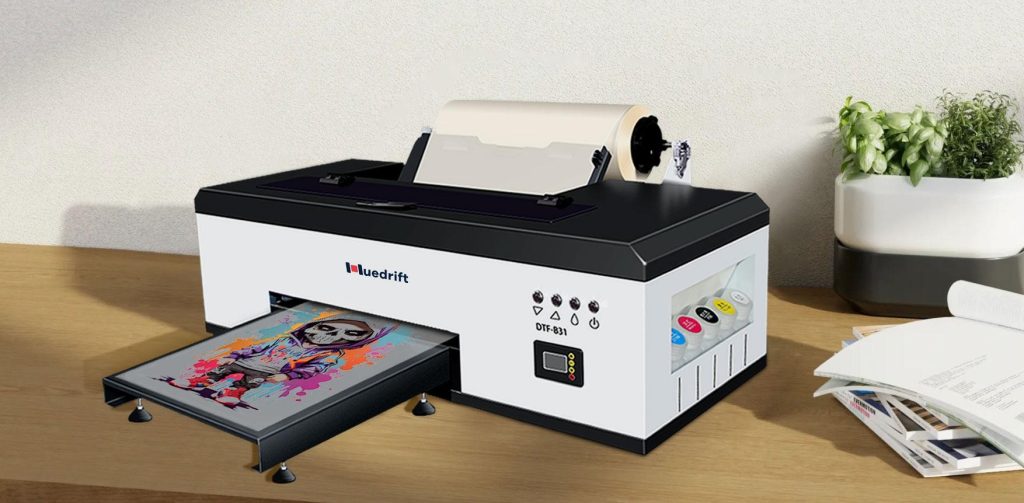
This is the decision most people overthink. The right printer is not the most impressive one on the spec sheet — it is the one that fits your current production reality and lets you grow into a better problem.
Huedrift makes three DTF printers, and they are genuinely different products for different stages of a brand. All three cover the same fundamentals: clean, vibrant output, compatibility with over 16 fabric types, a 12-month parts warranty, lifetime remote support, free video tutorials, and financing options that make the upfront cost manageable.
Huedrift One is where most independent designers should start. A3 print size covers everything you are likely to make early on — t-shirts, tote bags, hats, scarves. The controls are simple, switching between designs takes no time at all, and the compact size means it fits in a home studio without taking over the room. When something goes wrong — and something always goes wrong when you are learning — lifetime remote support means you are not figuring it out alone.
Huedrift Pro is the machine for labels that have found their footing and need to keep up with real order volume. Wider print widths, more detailed color layering, an advanced ink system that handles organic and recycled fabrics particularly well — the difference shows up most clearly on complex, design-forward work. The Huedrift Pro DTF Printer also integrates better with professional RIP and design software, which matters once you are managing multiple orders and cannot afford workflow friction slowing you down.
Huedrift Pro Max is for brands that have outgrown everything else. It has the widest print area and fastest production speed in the range, with professional-grade print heads and a frame built to handle sustained daily use without degrading. The built-in curing and drying system brings the full DTF process under one roof, which saves both space and time when you are printing at volume. Extended warranty coverage comes standard — at that level of use, it is not optional protection, it is a running cost you plan for.
There is no prize for buying more machine than you need on day one. Buy for where you are, and upgrade when the work demands it.
Step 5: Price Honestly and Defend That Price
On-demand costs more per unit than bulk production. That is just true, and pretending otherwise is a dead end.
The answer is not to find ways to shave the margin — it is to sell something worth paying for and explain why. Your customer is not buying a t-shirt. They are buying a garment that was made specifically because they ordered it, from fabric with a traceable supply chain, printed with a process that produced zero unsold inventory. That is worth real money to the right buyer.
Build your costs properly. Blank garment, ink and film, your labor, packaging, shipping — all of it goes in. A lot of independent makers forget to price their own time, which is how you end up building a brand that works beautifully and pays you nothing.
Some brands have had real success publishing their full cost breakdown publicly. It is a bold move, but it tends to generate exactly the kind of trust that turns first-time buyers into loyal customers.
Step 6: Make the Story Visible
The on-demand production story is genuinely interesting, but only if you tell it. It does not tell itself.
Write product descriptions that explain what on-demand actually means — that the garment your customer is holding was made after they placed their order, not pulled from a shelf. Show the process on social media. Film the printing, the pressing, the packaging. This is not filler content — it is evidence that the claims you are making are real, and it builds the kind of brand trust that advertising cannot buy.
The customers who understand and believe in what you are doing will bring you other customers. In sustainable fashion, that community effect is worth more than almost any paid channel.
The Bottom Line
None of this is as complicated as the fashion industry has historically made it seem. The materials exist, the technology works, the demand is real. What is required is the discipline to build something intentional — to make decisions based on values and stick to them when it would be easier not to.
On-demand printing does not eliminate the hard work of building a brand. But it removes most of the financial risk that used to make that work feel impossible. That is a genuinely different starting position than independent designers have had before, and it is worth taking seriously.