The Art of the Eco-Road Trip: Staying Active Without Leaving a Trace
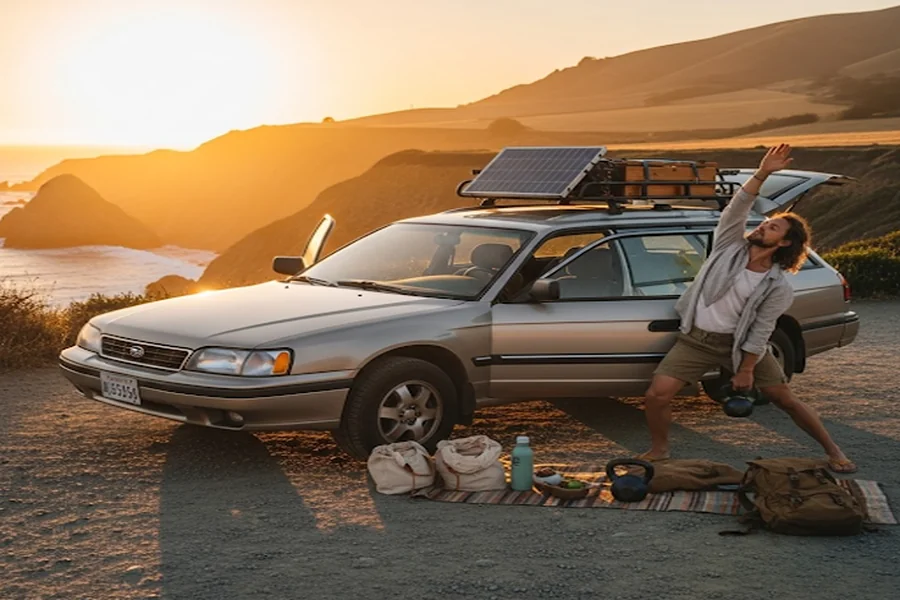
The Romance—and the Reality—of the Open Road
There is a specific kind of romance attached to the idea of a road trip that no other form of travel can quite replicate. It’s the promise of the horizon. It’s the feeling of rolling down the windows on a highway that stretches out like a ribbon of asphalt, the air rushing in smelling of pine or salt or dust, and the playlist perfectly synchronized with the golden hour light hitting the dashboard. For the first few hours, or even the first day, it feels like absolute freedom. You are untethered, spontaneous, and light.
And then, reality sets in.
Usually around day three, the physical toll of the “freedom” starts to manifest in your body. Your hips lock up from sitting in the same ninety-degree position for six hours at a time. Your shoulders creep up toward your ears, holding the tension of navigating unfamiliar traffic. Your digestion slows down, confused by a diet of convenience store snacks and irregular meal times. By the time you actually reach that breathtaking scenic overlook you drove five hundred miles to see, you are too stiff and lethargic to hike the trail that leads to the best view.
Sustainable travel discussions usually focus heavily on the external footprint: how much fuel we burn, the single-use plastics we refuse, the ethical businesses we support. These are critical, of course. But true sustainability is holistic. It doesn’t end with the health of the planet; it extends to the health of the traveler. If you arrive at your destination physically depleted and mentally fogged, you aren’t really experiencing the place—you’re just consuming it.
Travel that leaves your body wrecked quietly undermines the very experience it was meant to enrich. To travel sustainably is to maintain your own internal ecosystem just as carefully as you treat the external one.
Fueling Sustainably: Farmers Markets Over Gas Stations
One of the biggest culprits of “road trip fatigue” is the food ecosystem we default to. The highway is designed for efficiency, not nourishment.
Gas stations and fast-food drive-thrus are marvels of modern logistics, but they are soulless places. The food is engineered to be shelf-stable, not life-giving. When you rely on them, everything starts to taste the same—a blur of sodium, sugar, and plastic wrappers that pile up in the passenger footwell. The energy spike you get from a sugary coffee or a bag of chips is sharp and immediate, but the crash that follows is inevitable, leaving you foggy and irritable behind the wheel.
Changing this requires a shift in how we view “stops.” Instead of seeing food as just fuel to get back on the road, I started treating it as a way to connect with the region.
Finding a local farmers market or a small-town grocery store takes more effort than pulling off at a highway exit. You have to check hours, detour a few miles, and maybe deal with limited parking. But the reward is grounding. Eating an apple that was grown five miles away, or buying a loaf of bread wrapped simply in paper, changes your relationship to the landscape. You aren’t just passing through a blur of scenery; you are tasting the place.
It’s not about being rigid or perfect. There will be days when it’s raining, you’re exhausted, and a drive-thru is the only option that keeps you sane. Convenience has its place. But whenever possible, choosing food that is closer to the source keeps both the physical waste and the bodily sluggishness to a minimum. It makes the act of eating feel less like mindless consumption and more like active participation in the local economy.
The “World Is Your Gym” Mindset
The beauty of slow travel is that it gives you permission to stop “exercising” and start “moving.”
In our normal lives, fitness is often compartmentalized. We go to the gym for an hour to undo the damage of sitting for eight. But on the road, movement can be woven into the fabric of the day.
A morning walk along a foggy coastline isn’t just “cardio”; it’s how you wake up and greet the ocean. A short, steep hike to a waterfall becomes your afternoon activity, not a slot on a training calendar. Exploring a new town on foot—getting lost in the winding streets, climbing the stairs to a cathedral view—adds thousands of steps of motion without any intention or pressure.
When movement is integrated into exploration, the psychological burden lifts. You move because you are curious, not because you are keeping score or trying to burn off lunch.
However, we have to be realistic. Not every day cooperates. There are days when the weather turns torrential, or when a ten-hour drive leaves you arriving at your Airbnb in pitch darkness. There are moments when you need to discharge energy, but the outside world isn’t an option.
The Minimalist “Trunk Kit”
There are days on the road when the world feels a little too much. Maybe it’s the rain tapping steadily on the roof of your van or rental car. Maybe it’s the sensory overload of navigating a new city. Maybe you just need to feel grounded in your own body before you can face another day of driving.
For me, that is when a small, dedicated trunk kit becomes invaluable.
I view packing for a long trip like a high-stakes game of Tetris. Every square inch of the trunk matters. Between the cooler, the hiking boots, the camera gear, and the emergency supplies, there is zero room for vanity items. That is why I rely on the FED Fitness adjustable set.
This compact kettlebell and dumbbell set earned its place in my trunk not because I’m obsessed with gains, but because it survived a brutal elimination process based on logistics.
First, there was the space issue. I needed something that could provide legitimate resistance but occupied less than 0.2 square meters—roughly the footprint of a hiking boot box. I could tuck it next to the spare tire or shove it behind the driver’s seat, and it wouldn’t eat up valuable luggage space.
Second, and perhaps more importantly, was the noise factor. Anyone who has driven down a gravel road with loose metal weights knows the torture of that constant clank-clank-clank. Because these weights are coated in eco-friendly PE material, they are silent. They don’t rattle. They don’t scratch up the back of the rental car. And if I’m using them on the fragile floor of a borrowed Airbnb or a hotel room, I don’t have to worry about damaging the property.
It doesn’t come out every day. Sometimes it stays untouched for three days straight while I’m hiking. But on those rainy Tuesday evenings in a motel room, having it there allows me to do twenty minutes of movement that resets my nervous system. It’s not about a strict regimen; it’s about having the option to release tension without leaving your room.
Rituals That Ground You
Travel has a unique way of dissolving routines. That is part of its charm—the breaking of the mold—but after a week or two, it can also be disorienting. You wake up forgetting where the bathroom is. You forget what day it is.
Small, portable rituals help anchor you in the chaos.
These aren’t rigid schedules. They are just familiar touchpoints that tell your body: “We are safe. We are here.” It might be the way you make your coffee in the morning, taking five minutes to stretch while the water boils. It might be a few quiet movements on the balcony before the rest of the travel group wakes up.
I’ve learned that the tools you keep close matter less for what they do than for how they make you feel using them. I gravitate toward gear that feels thoughtfully made and aligned with the values of the trip itself. When something like FED Fitness sustainable travel gear becomes part of a morning routine, it feels seamless. It’s not a piece of aggressive gym equipment shouting at me to work harder; it’s just a quiet tool that fits into the slow rhythm of the morning.
Some mornings, the gear stays packed away because the hike ahead is enough. Other days, it helps bring a sense of normalcy to a strange place. Either way, the ritual remains flexible, serving the traveler rather than demanding obedience.
Conclusion: The Journey Within
At the end of the day, staying active while traveling isn’t about discipline, optimization, or maintaining a beach body. It is about preserving enough energy—physical, mental, and emotional—to actually experience where you are.
When your hips aren’t tight, the long drive feels like an adventure, not a chore. When your body feels supported and strong, the detour to the hidden beach feels like an invitation, not a hassle.
Caring for yourself with the same mindfulness you bring to sustainable travel doesn’t complicate the journey. It deepens it.
And mile by mile, that quiet attention makes the landscape feel more alive—both the one outside the window and the one inside yourself.