How to build strength without running or jumping
If you have been told to stay off high-impact exercise, whether for bad knees, hip issues, or a history of stress fractures, it is easy to assume your training options just shrank. They did not. Impact is one way to make a workout hard, but it is not the only way, and it is not required for either cardiovascular or strength results. Once you understand that, a whole category of training opens up, and the first step is usually as simple as deciding to book your first class in a format built without the pounding. This guide explains why impact is optional and which approaches actually deliver.
Start with the key distinction: impact and intensity are not the same thing. Impact is the force your body absorbs when it strikes a surface, such as your foot hitting the ground in a run or landing from a jump. Intensity is how hard your muscles and cardiovascular system are working. You can dial intensity all the way up while keeping impact at zero, because the two are controlled by different variables. High-impact formats simply bundle them together; low-impact formats separate them on purpose.
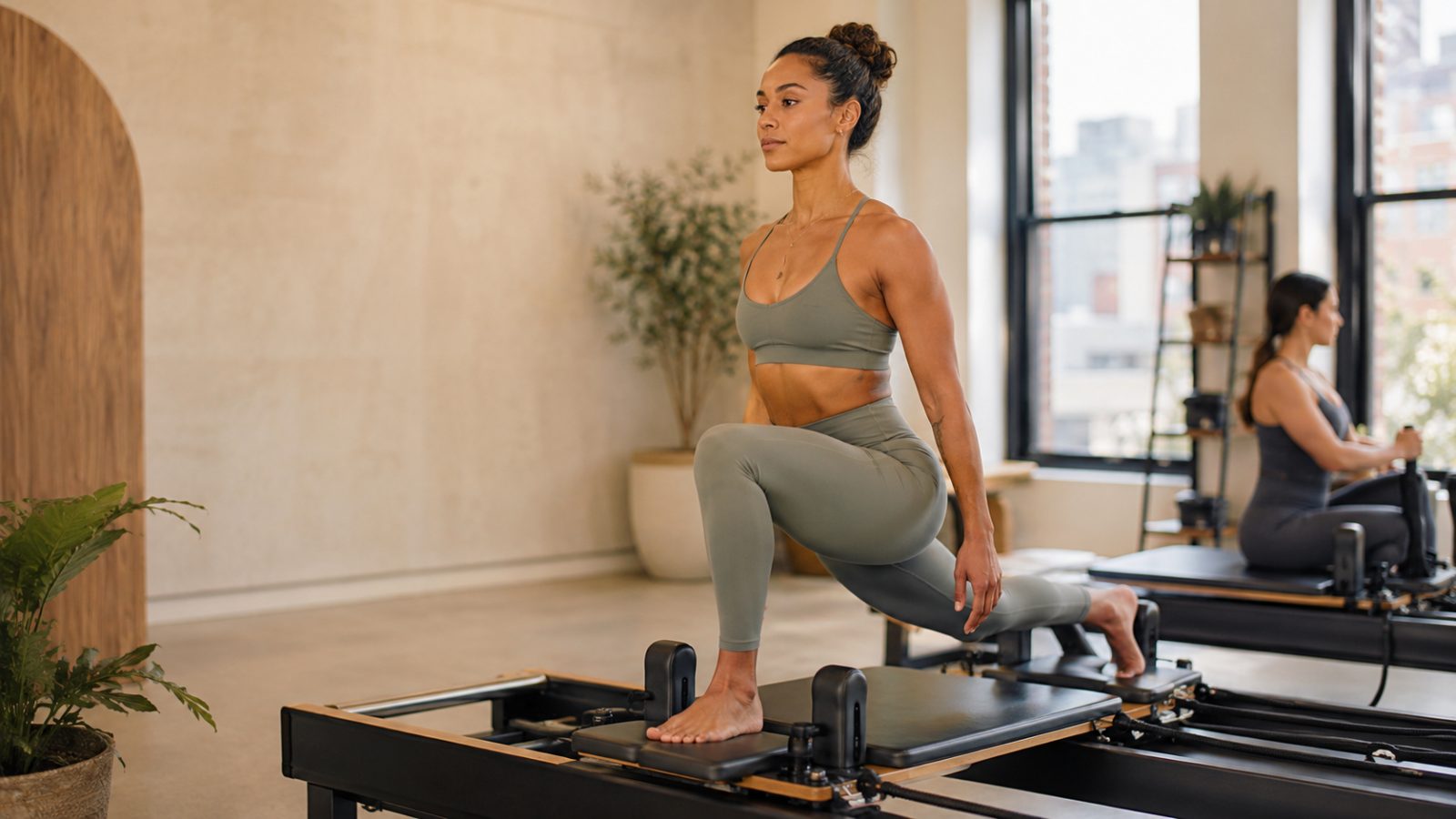
That separation matters most for the joints. Every stride while running sends a ground-reaction force of roughly two to three times your body weight up through your ankles, knees, hips, and spine, and jumping raises that further. Do enough of it and the cumulative load is what aggravates old injuries and keeps people from training consistently. Remove the impact and you remove that cost without lowering the effort. Spring-based reformer training is a clear example: at a studio like FORM50 Williamsburg in Brooklyn, the entire session runs on a spring-loaded carriage, so the muscles work hard against resistance while the joints never absorb a landing.
Why impact and intensity get confused
Bootcamp and traditional interval classes reach high heart rates through explosive, impact-heavy moves: sprints, jump squats, burpees. Because those movements feel intense, people conclude the impact is doing the work. It is not. The intensity comes from the metabolic and muscular demand, which you can generate just as well through resistance, tempo, and short rest. The jumping is incidental, and for many bodies it is the part that causes problems.
What ground-reaction force costs you
Impact is not inherently bad; bones and tendons adapt to load, and some impact is healthy. The issue is volume. Repeated high-impact work, session after session, accumulates faster than many joints can recover from, especially if you are managing an existing issue. The result is a familiar pattern: train hard, flare up, rest, restart, and never build momentum. Lowering impact is one of the simplest ways to break that cycle, because it lets you train more often without paying the joint tax each time.
Low-impact formats that still build real strength
Several approaches deliver genuine strength and conditioning with little or no impact:
|
Format |
Strength stimulus |
Conditioning stimulus |
Impact |
|
Spring-based reformer training |
High (constant tension) |
High (short rest intervals) |
Zero |
|
Resistance-machine circuits |
High |
Moderate to high |
Low |
|
Kettlebell and dumbbell strength work |
High |
Moderate |
Low |
|
Cycling or rowing intervals |
Moderate |
High |
Low |
|
Swimming |
Moderate |
High |
Zero |
The common thread is that resistance and interval structure, not impact, drive the adaptation. Pick the one you will do consistently.
How spring resistance loads muscle without joint compression
Spring-based training deserves a closer look because it solves the strength side particularly well. On a reformer, you push and pull a carriage against adjustable springs. The resistance is constant through the full range of motion, including the return phase, which is often passive with free weights. That means more time under tension, one of the primary drivers of building and maintaining lean muscle, without loading the joint through a compressive, gravity-driven path. You get the muscular demand of strength work while the springs absorb what the ground would otherwise deliver.
Because the resistance is adjustable, the same movement scales from a rehab-friendly load to a genuinely hard one, which is why these formats work for a wide range of starting points.
A simple weekly framework
You do not need impact anywhere in a well-rounded week. A workable structure:
- Two to three resistance-based sessions for strength, using machines, springs, or free weights.
- One to two low-impact conditioning sessions, such as cycling, rowing, or interval-style reformer work.
- One mobility or recovery day to keep joints moving without loading them hard.
Progress by adding resistance or reducing rest, not by adding impact. If you are working around a diagnosed injury, clear your plan with your doctor or physical therapist first, and treat any sharp joint pain as a signal to scale back rather than push through.
Common mistakes when you drop the impact
Going low-impact works, but a few habits quietly undercut it. The first is coasting. Because there is no jumping to signal effort, some people unconsciously ease off and never reach a challenging zone. Low impact is not low intensity; you still need to work hard enough that the last few reps of a set are genuinely difficult.
The second mistake is skipping progressive overload. Muscles adapt to a stimulus and then need more, so if your resistance, tempo, or volume never changes, neither will your strength. Track something, whether it is spring load, weight, reps, or rest, and nudge it upward over time.
The third is dropping conditioning entirely. Removing impact does not mean removing intervals. Short work-to-rest cycles on a bike, rower, or reformer keep your cardiovascular system challenged without a single landing. Build the week so that strength and conditioning both have a place, and the low-impact approach holds up against anything.
The bottom line
Impact is a tool for raising intensity, not a requirement for results. If your joints do better without running and jumping, you can still build real strength and conditioning by leaning on resistance, tempo, and interval structure instead. Spring-based reformer training is one of the cleaner ways to do it, which is a big part of why FORM50 built its whole low-impact method around the idea that hard and high-impact do not have to mean the same thing.