The Art of Living Well in a City That Never Stands Still
Dubai does not ease people in. It presents finished results first, towers, waterfront districts, controlled environments, then continues building behind them without pause. The entry point into the city is not culture or history. It is property. High end developments define the first layer of understanding.
Emaar Properties shapes Downtown and large parts of the skyline. DAMAC Properties pushes residential scale into new districts. Sobha Realty focuses on controlled communities with internal infrastructure. Binghatti Developers experiments with architectural identity in high-density zones.
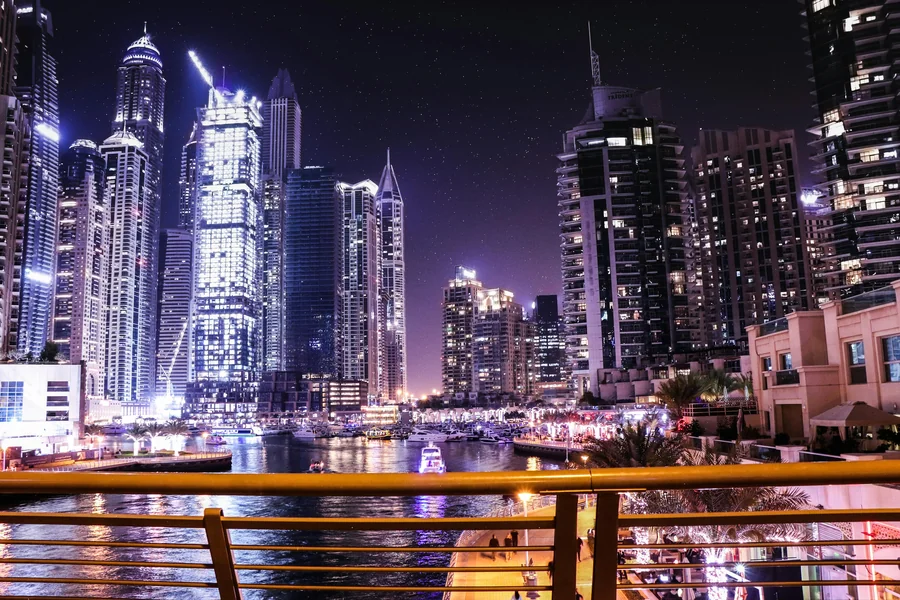
Projects like Burj Khalifa, Palm Jumeirah, and Dubai Marina are anything but isolated landmarks. They are operational districts with residential towers, retail, access roads, and their own internal services running continuously. Living here, it starts with understanding that these are systems rather than only statements.
Districts That Function as Separate Environments
Dubai is not a single urban experience. It is a collection of zones with different operating logic. Moving between them feels less like commuting and more like switching systems.
Each district defines how time is used, how movement happens, and how space is occupied.
Downtown Dubai: Vertical Density With Continuous Load
Downtown Dubai operates at real high density. It’s filled with constant activity. Residential towers, office buildings, retail spaces, and leisure spots – they all sit within walking distance but movement remains controlled by traffic flow and internal access routes.
Dubai Mall functions as more than retail. It acts as a climate-controlled extension of the district. People move through it as a primary pathway, not just a destination.
Dubai Fountain runs on scheduled cycles, creating periodic congestion that redistributes foot traffic across the area.
Living here requires adjusting to vertical movement. Elevators replace streets. Parking structures replace open access. The system works, but it demands awareness of timing.
Jumeirah and Coastal Spread
Jumeirah shifts the structure. Its layout is horizontal, it’s full of villas with direct beach access, therefore it introduces much lower building density.
Jumeirah Beach provides open coastline with public access points like Kite Beach and Sunset Beach. Movement is less compressed. Space extends outward instead of upward.
This changes daily patterns. Walking becomes viable. Cycling routes extend along the coast. Traffic exists, but it spreads rather than concentrates.
The district operates at a slower visual pace, but the underlying system remains active.
Work Zones That Operate Independently
Work in Dubai is not tied to residential districts. It clusters in specific zones designed for efficiency and controlled access.
These zones function with their own internal rules.
DIFC: Financial Precision Without Flexibility
Dubai International Financial Centre operates as a separate, regulated financial zone, with its own legal framework. DIFC has its office towers, dining spaces, and pedestrian routes all tightly integrated.
Movement here is direct. Meetings run on time. Space is optimized for transactions, not lingering.
Restaurants like Zuma and LPM operate inside the same grid, allowing transitions between work and social interaction without leaving the district.
The environment removes ambiguity. It expects clarity in use.
Business Bay: Extension Without Identity
Business Bay sits next to Downtown but functions differently. It absorbs overflow, residential towers, offices, hotels, without forming a singular identity.
The canal running through it adds visual structure, but movement remains vehicle-dependent. Walking is possible in sections, not across the entire district.
It operates as a connector. Not a destination on its own, but essential for how adjacent areas function.
Movement Systems That Control Everything
Dubai is built around movement. Roads define access. Without understanding them, the city becomes inefficient.
Sheikh Zayed Road: The Main Axis
Sheikh Zayed Road runs straight through the city. It connects major districts from the World Trade Centre area with Dubai Marina.
It operates at high capacity. Multiple lanes, constant flow, frequent congestion during peak hours.
Entry and exit points determine travel time more than distance. Missing a turn can add significant delay.
This road is not optional. It is the central spine.
Dubai Metro: Controlled Alternative
Dubai Metro is seen as a predictable alternative to road travel. The Red Line connects 3 major spots – DXB Airport, Downtown, and Dubai Marina.
Stations like Burj Khalifa/Dubai Mall and DMCC act as major nodes. Movement here is time-based, not traffic-based.
The system works best for linear travel. It does not fully replace road networks but reduces dependency in key corridors.
Spaces That Interrupt the System
Dubai includes environments that break its own pattern. These are not escapes. They are controlled interruptions.
Al Fahidi: Pre-Development Structure
Al Fahidi Historical Neighborhood presents a preserved district with wind towers, narrow lanes, and low-rise buildings.
Movement slows automatically. Paths are tight. Shade replaces open exposure. The scale forces adjustment.
It shows a version of the city before vertical expansion. Not nostalgic, but structurally different.
The Desert: External Reset With No Infrastructure
Dubai Desert Conservation Reserve sits outside the city grid. No towers, no controlled environment, no layered services.
Sand, heat, open space. Movement becomes minimal. Time perception shifts due to lack of reference points.
Access requires planning, but once inside, the system drops away.
Residential Logic: Selection Over Location
Living in Dubai is not about proximity alone. It is about alignment with how a district operates.
Different areas require different patterns of use.
Dubai Marina: Continuous Activity Loop
Dubai Marina operates as a closed loop of residential towers, retail, and waterfront paths.
The Marina Walk provides a continuous pedestrian route. Restaurants, cafes, and services line the path.
Activity does not drop to zero. It fluctuates but remains present.
Noise, movement, density, all part of the system. Living here requires tolerance for constant input.
Arabian Ranches: Controlled Isolation
Arabian Ranches shifts to gated, low-density housing with internal roads and limited external interaction.
Movement requires a car. Services are contained within the community or accessed through short drives.
The system prioritizes separation over integration.
Social Structure: Selection as a Filter
Dubai offers volume. Restaurants, events, venues, all operating simultaneously.
The difference comes from selection.
DIFC and City Walk: Controlled Social Environments
City Walk and DIFC provide structured social settings. Restaurants spaced with intention, pedestrian-friendly layouts, controlled lighting and design.
Interaction happens in defined environments. Not random, not chaotic.
These areas filter crowd types through pricing, location, and design.
Marina and JBR: Open Access Volume
Jumeirah Beach Residence increases volume. More accessible, more movement, less control over crowd composition.
The Walk at JBR runs parallel to the beach, combining retail, dining, and public access.
It operates continuously, with less filtering.
System Outcome: Continuous Construction, Continuous Adjustment
Dubai does not stabilize. Districts evolve. Towers appear. Road systems adjust.
The city operates as a live system, not a finished one.
Living inside it requires tracking changes, understanding movement patterns, and selecting environments that match intended use.
The skyline is visible. The system behind it is what matters.