The Ethical Luxury Shift: Why Zero-Mining Moissanite is Redefining Conscious Fine Jewelry

To the contemporary conscious consumer fashion is not only a matter of aesthetics anymore: it has a direct relation to personal values. The growing use of capsule wardrobes, organic fabrics, and closed-loop production throughout the last ten years has radically changed the way we think about our wardrobes. However, jewelry has mostly been a thorny exception to the sustainability discourse. Since time immemorial, standard gemstones involved an excessive environmental and societal price, and it is frequently disguised beneath slick marketing.
A thick paradigm shift is occurring today with advocates of sustainable style considering more than subterranean mining to technological advancements. First in line of this campaign is silicon carbide that in high-fashion lingo can be called moissanite: a zero-mining substitute that has merged unrivaled optical brilliance with unbending environmental ethics.
2. The True Ecological Footprint: Subterranean Mining vs. Lab-Engineered Brilliance
To recognize the reason behind the use of zero-mining jewelry as an important element in the environmentally friendly lifestyle, one has to trace the harsh environmental facts concerning the traditional mining of gems. It takes more than 250 tons of earth to extract one carat worth of mined diamond, the use of which requires a lot of fossil fuels, depleted biodiversity, and produced a lot of carbon funds. In addition, acid mine drainage and soil erosion rarely leave enduring footprints in the local ecosystems.
Conversely, Moislanite produced in a lab is created in controlled, high-energy settings, using sophisticated thermal energy. Since it is manufactured without heavy earth-moving devices, devastation of habitats and toxic leachates, its ecological footprint accounts to a fraction of pennies compared to mined stones.
Supply Chain Transparency and Ethical Verification
Other than the conservation of the environment, human imprint of jewelry cannot be overlooked. The use of traditional supply chains is famously opaque, as rough stones go through several intermediaries, across several continents, before they reach the final consumer, which is extremely challenging to ensure that human rights are met.
Zero-mining moissanite gets all of these ethical dilemmas out of the way. Lab-grown gems are synthesized in advanced laboratories with well-regulated environmental standards, which ensures that their provenance is completely traceable and their entire provenance, between initial synthesis and end hand-setting, is 100% conflict-free.
3. Expert Insights: Crafting Sustainable Brilliance for the Modern Collector
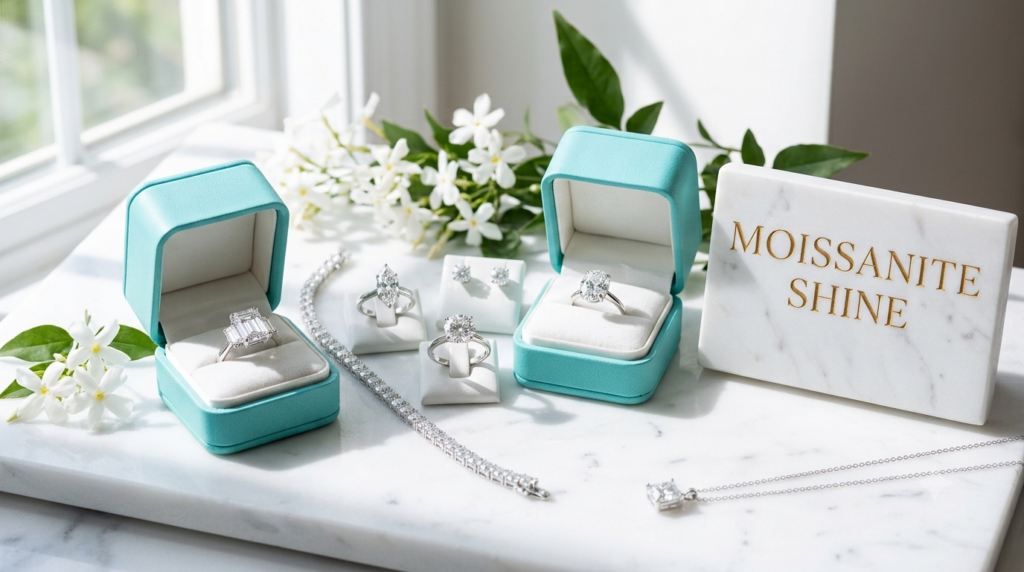
In order to understand the intercept of ethical gemology with modern designing, we have interviewed Ahmed Eid, director in the industry, gemstone specialist and founder at Moissanite Shine LLC. Eid has made his career researching the stone physics, supply chain ethics, and intentional consumer-centered sustainable manufacturing models.
According to Eid, sustainability in fine jewelry is not merely the process of not harming but raising craftsmanship by providing scientific innovation. Silicon carbide is a material with a larger refractive index than mined diamond; that is, its light scattering and color fire are inherently better. The conscious customers do not have to make a decision between their environmental values and fancy appearance any longer. When a collector selects hand-finished moissanite rings crafted in recycled solid gold or platinum, they bequeath to them a durable masterwork that will serve as long a duration as the Ganges Valley lies unchallenged on the battlefield. This is what modern ethical lustre means.
The view of Eid underlines a significant shift in the way people approach luxuries in the future: artificial scarcity and environmental displacement have ceased being a sign of a real prestige, but the purposeful intentions, physical permanence, and balance with nature.
4. The Sustainable Capsule Wardrobe: 5 Essential Jewelry Anchors
At the same time, much in the same way that a sustainable clothing capsule is built on the idea of versatile, high-quality basics like organic silk shirts, custom linen blazers, and ethical wool coats, a conscious jewelry collection is built around the premises of interchangeable and timeless items that one can wear every day.
1. The Solitaire Ring: Architectural Simplicity
One, immaculately hewn solitaire rock on a bare bone of a band is all that ever needed to be the final word in slightly sophisticated discrimination. The traditional solitaire is going to give the greatest visual usefulness with straightforward clear and simple lines and may be matched with a simple day wear or party wear because of its simplicity.
2. Face-Framing Ear Adornments: Everyday Radiance
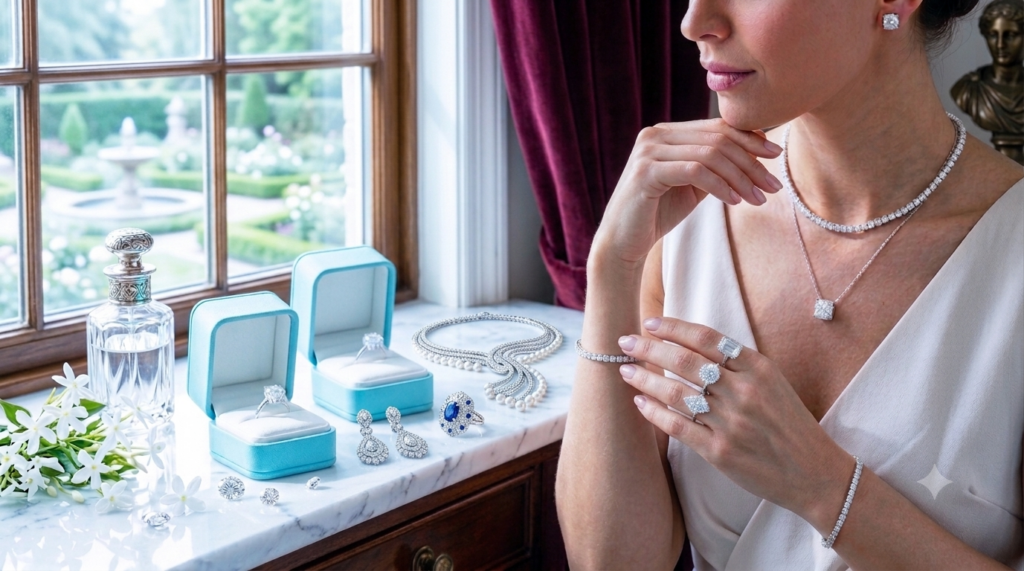
Earrings work as the major frames of the face reflecting ambient lighting and emphasizing the face features. To have a sustainable wardrobe capsule, it is important that the items are versatile: they should be applicable at the office during the day and at the party during the evening.
When selecting face-framing decor, it is important to consider the interaction of the light colors with skin color and material of natural fabrics says Eid. Be it your aesthetic skewing more towards clean bezel-set studs or more elegant drop designs, selecting hand-cut moissanite earrings ensures enduring clarity and maximum brilliance without requiring high-maintenance care. These pieces form the foundational baseline of a truly conscious jewelry collection.”
3. The Fluid Tennis Bracelet: Modern Wrist Architecture
An iconic tennis wrist watch brings about texture and rhythmical glitziness to the wrist. A tennis bracelet made with lab grown moissanite will provide a seamless band of glittering lights which can be worn alone to provide a clean architecture or worn with a sustainable time car.
4. The Minimalist Collar Pendant: Decolletage Accentuation
There is a fine pendant at the collarbone that causes a small amount of attention to the neckline. An open linen collar, V-neck knits, or organic cotton blouse are ideals to pair a round or cushion-cut pendant, which will offer a focal point of light encouraging a complete silhouette.
5. Conscious Metal Pairings: Recycled Gold and Platinum
Sustainable metal sourcing is demanded by ethical gemology. With certification of recycles on yellow gold, rose gold, or platinum, a combination of zero-mining stones with these will guarantee that the entire item goes hand in hand with the principles of the concept of a circular economy, so that the surplus metal mining will not occur, and the structure of the heirloom will remain intact.
5. Durability as Sustainability: The Physics of Lifetime Permanence
Longevity of the products is the most significant yet least discussed measure in the discussion on eco-conscious living. Inequality simulants, such as cubic zirconia or glass, which are cheaply made fashion jewelry of base metals easily tarnishes, scratches and clouds, and soon finds its way to a landfill months later. This is the opposite of sustainability, which is a cycle of waste in fast-fashion.
With a Mohs hardness scale reading of 9.25, moissanite is extremely tough against scratching, chipping, and thermal shock. It comes in second only to diamond in terms of hardness, so its optical brilliance, and structural integrity will never become washed out during the course of time. This basic principle of sustainable life buy better, wear forever, comes to its final realization in silicon carbide jewelry.
6. Conclusion: Elevating Fashion Through Intentional Choice
With the fashion industry in the much needed shift towards environmental accountability and thoughtful and environmentally responsible usage, zero-mining moissanite is much more than a fad–it is an evolutionary leap in the field of fine jewelry. Combining a high level of gemological physics with ethical accountability, the designing of jewels nowadays reveals that more luster is brought to light when it leaves behind zero shadow on earth.