Lab-Grown vs. Natural Diamonds – Which Is Right for You in 2026?
You are about to spend anywhere from $2,000 to $25,000 on a single piece of jewelry. The person selling it to you has a financial interest in your decision. And the two options in front of you — lab-grown and natural diamonds — look completely identical under showroom lights.
This guide does not have a stake in which you choose. What it does have is data, context, and an honest account of where each option genuinely falls short. By the end, you will have a clear framework for making the most financially and emotionally sound decision for your specific situation.
One important note before we begin: this is not a question with a universally correct answer. Couples who buy lab-grown diamonds in 2026 are not making a compromise. Couples who buy natural diamonds are not being irrational. The decision depends entirely on which variables matter most to you — and those variables differ from couple to couple in ways no blanket recommendation can resolve.
The Science First: Are Lab-Grown Diamonds Real Diamonds?
This question comes first because it is the one that causes the most confusion, and the answer is unambiguous.
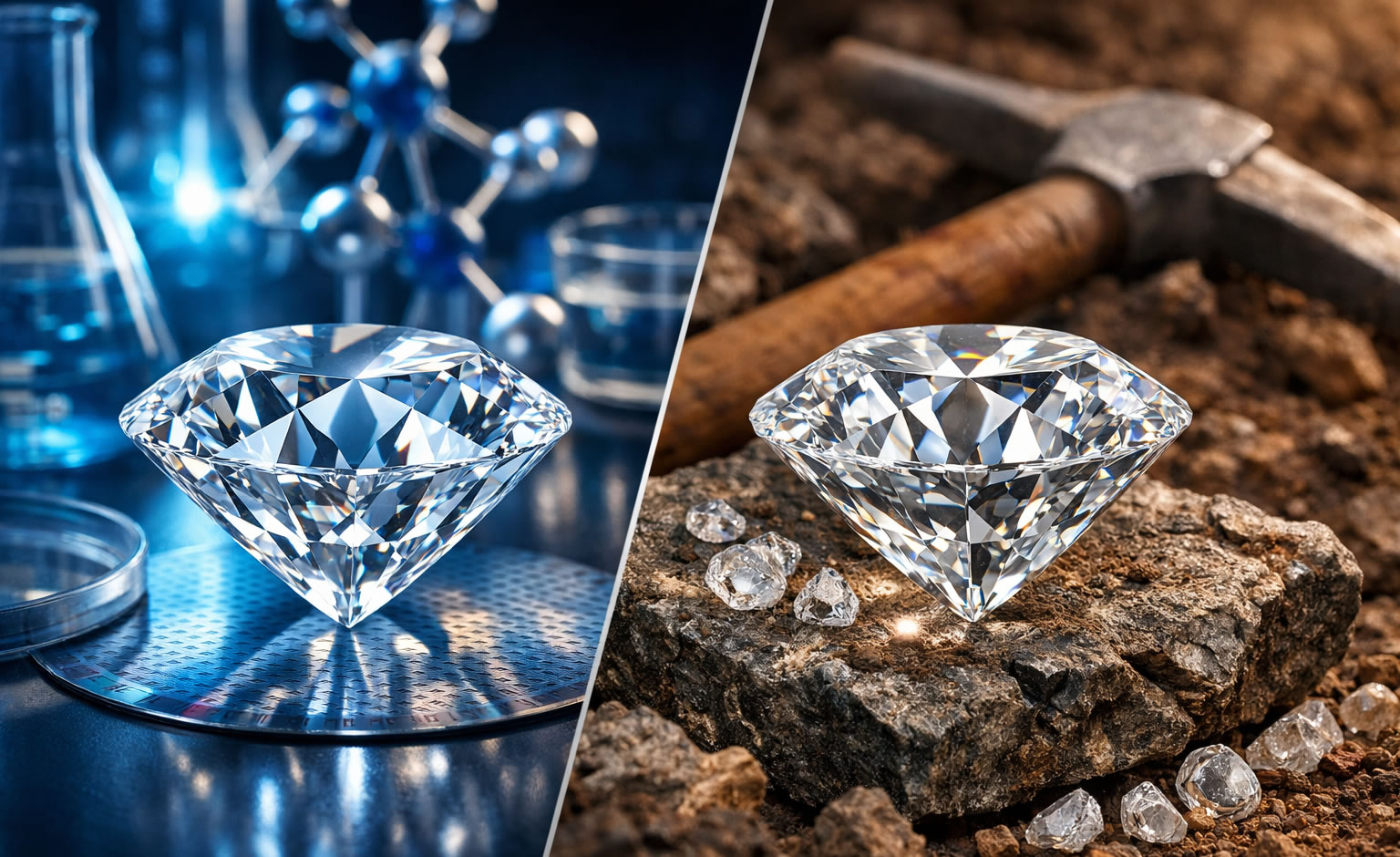
Lab-grown diamonds are chemically, physically, and optically identical to natural diamonds. Both consist of pure carbon atoms arranged in a cubic crystal lattice. Both register 10 on the Mohs hardness scale — the maximum possible. Both exhibit the same refractive index (2.417), the same dispersion rate, the same fire and brilliance. A gemologist examining a lab-grown diamond without specialized equipment cannot distinguish it from a mined stone.
This is not marketing language. It is basic materials science.
How lab-grown diamonds are actually made
Two primary methods are used to grow diamonds in laboratory conditions:
CVD (Chemical Vapor Deposition): A diamond seed crystal is placed in a sealed chamber filled with carbon-rich gas (typically methane). Microwaves heat the gas to approximately 900–1,200°C, breaking down the molecules and depositing carbon atoms layer by layer onto the seed. The process takes 6–12 weeks for a 1–2 carat stone.
HPHT (High Pressure High Temperature): Carbon is subjected to pressures exceeding 1.5 million pounds per square inch and temperatures above 1,400°C — conditions that replicate the geological environment roughly 100 miles below Earth’s surface. The carbon crystallizes around a diamond seed. HPHT produces stones more quickly than CVD but is technically more difficult to scale.
Both methods produce genuine diamonds. Neither produces simulants like cubic zirconia or moissanite, which are chemically and structurally different materials.
What distinguishes them under testing
While the human eye cannot differentiate the two, specialized equipment can. Devices such as the De Beers DiamondView use short-wave UV fluorescence to reveal growth patterns unique to each origin. HPHT-grown diamonds often display cubic or cuboctahedral growth sectors invisible to the naked eye. CVD diamonds may show distinctive strain patterns.
This matters for one reason: reputable grading labs can and do identify lab-grown origin and disclose it on the certificate. A diamond sold without a grading report — or without origin disclosure — is a red flag regardless of whether it is lab-grown or natural.
The Price Reality in 2026: What Your Budget Actually Gets You
This is where the conversation becomes substantive. The price difference between lab-grown and natural diamonds is not marginal. It is structural.
Current price benchmarks (Q1 2026)
The following figures represent retail averages across major certified jewelry retailers. Prices assume GIA or IGI certification, excellent or ideal cut grade, G–H color, and VS1–VS2 clarity.
| Carat weight | Natural diamond (retail) | Lab-grown diamond (retail) | Price difference |
| 0.75 ct | $2,800 – $3,800 | $400 – $700 | ~80% less |
| 1.00 ct | $4,500 – $6,500 | $800 – $1,500 | ~78% less |
| 1.50 ct | $9,000 – $14,000 | $1,400 – $2,500 | ~82% less |
| 2.00 ct | $16,000 – $26,000 | $2,500 – $4,500 | ~83% less |
| 3.00 ct | $38,000 – $60,000+ | $4,500 – $8,000 | ~85% less |
Price ranges reflect variation by retailer, specific 4Cs grades, and shape. Fancy shapes (oval, marquise, pear) may vary significantly.
This price gap has widened steadily since 2018. Lab-grown diamond prices have declined approximately 90–95% from their 2018 levels due to improvements in production efficiency and market saturation. Natural diamond prices, by contrast, have remained relatively stable to slightly declining in the mid-tier segment.
What $5,000 actually buys you in 2026
This is perhaps the most clarifying exercise for most buyers:
With $5,000 on a natural diamond: You can reliably purchase a 0.80–1.00 carat round brilliant in G–H color and VS2 clarity with excellent cut. This is a beautiful ring. It is not a statement stone.
With $5,000 on a lab-grown diamond: You can purchase a 2.00–2.50 carat round brilliant in the same color and clarity grades, with budget remaining for a meaningful setting. According to The Knot’s 2026 Real Weddings Study, the average lab-grown center stone purchased this year measured approximately 2.45 carats — nearly double the 1.16-carat average for natural diamond rings bought at equivalent price points.
This is the defining practical reality of the 2026 engagement ring market: lab-grown diamonds have democratized size.
The price trajectory caveat
Here is where intellectual honesty is required. Lab-grown diamond prices have not stabilized. They continue declining at approximately 15–20% annually as production scales. A lab-grown diamond purchased today for $2,000 may have a replacement value of $1,200 in three years.
This has no practical consequence if you intend to keep the ring indefinitely. It has significant consequences if you view the stone as a financial asset, plan to upgrade, or expect to insure it at purchase value over decades. We return to this in the resale value section.
The Diamond Value Equation: Resale, Investment, and the Question Nobody Asks
We define the Diamond Value Equation as the total return on a diamond purchase, accounting for emotional utility, practical resale potential, and long-term cost of ownership. Understanding each component separately prevents the most common mistake buyers make: optimizing for one variable while ignoring the others.
Natural diamonds: the resale reality
Natural diamonds are often described as an investment. The reality is more nuanced.
In the secondary market — estate sales, resale platforms like Worthy, or jewelry buyback programs — a natural diamond typically recovers 20–50% of its retail purchase price. Retail markup on natural diamonds is significant: wholesalers and designers add 50–200% above cost depending on the retailer tier. A $7,000 diamond purchased at a boutique jewelry store is rarely worth $7,000 the following week.
That said, certain natural diamonds do hold value better over time:
- Stones above 3 carats in excellent condition
- Fancy colored natural diamonds (yellow, pink, blue)
- Certified stones with GIA grades in rare color/clarity combinations
- Antique and vintage cuts (Old European, Old Mine) with original provenance
For the majority of engagement ring purchasers buying a 1–2 carat round brilliant, resale value is a theoretical benefit that rarely materializes. Most rings are never sold. Of those that are, the return is modest at best.
Lab-grown diamonds: the resale reality
Here, intellectual honesty is even more important. Lab-grown diamonds currently have near-zero secondary market value as standalone stones.
As of 2026, resale platforms report that lab-grown diamonds — even high-quality certified stones — sell for 5–15% of their original retail price, and often cannot find buyers at any price. The reason is structural: new lab-grown diamonds at retail are already 80% cheaper than natural equivalents, so why would a buyer pay secondary market prices for a used stone when new inventory is readily available and falling in price?
This does not mean lab-grown diamonds are a poor choice. It means they are not a financial vehicle. They are a piece of jewelry. If you are clear about that distinction, lab-grown diamonds offer extraordinary value. If you entered the purchase expecting resale optionality, you will be disappointed.
The practical conclusion: For the vast majority of couples, resale value should not be the deciding factor. The probability of selling an engagement ring is low, and the emotional cost of doing so is high. Optimize for what makes the ring meaningful to wear, not what makes it theoretically liquid.
Ethics and Environment: The Honest Version
Both natural and lab-grown diamond industries have positioned themselves on the moral high ground. Neither position is entirely accurate.
The natural diamond supply chain
The Kimberley Process Certification Scheme, established in 2003, was designed to prevent conflict diamonds from entering the legitimate market. It has significantly reduced the flow of conflict stones. It has not eliminated it. The scheme’s definition of “conflict diamond” is narrow — limited to stones funding rebel movements against recognized governments — and excludes diamonds mined under exploitative labor conditions, in regions with documented human rights violations, or by state actors committing atrocities.
Reputable retailers source from established, traceable supply chains in Canada, Botswana, Namibia, and Australia — countries with comparatively strong labor and environmental oversight. De Beers’ Forevermark program and brands like CanadaMark provide additional traceability. If ethical sourcing matters to you, verified Canadian or Botswana-origin diamonds with chain-of-custody documentation represent a meaningfully better option than uncertified stones.
The lab-grown energy question
Lab-grown diamonds are frequently marketed as sustainable. The reality depends on the energy source.
Growing a 1-carat diamond via CVD requires an estimated 250–750 kWh of electricity. That is equivalent to running a household refrigerator for 3–8 months. If that electricity comes from coal-powered grids — which power a significant share of diamond-growing facilities in China and India — the carbon footprint may exceed that of a responsibly mined natural diamond.
Lab-grown producers powered by renewable energy (hydroelectric, wind, solar) achieve dramatically lower emissions. Asking specifically about energy sourcing is a reasonable due-diligence question when purchasing a lab-grown diamond.
The honest summary: Neither option is inherently more ethical. Responsible sourcing requires active investigation on the buyer’s part — not a default assumption based on origin type.
The 4Cs Applied: How to Read a Diamond Certificate in 2026
Whether you are buying natural or lab-grown, the 4Cs framework — Cut, Color, Clarity, and Carat — determines the actual appearance of the stone. Understanding how each variable interacts saves money without sacrificing visual impact.
Cut: the most important variable by a significant margin
Cut grade governs how a diamond interacts with light — its brightness (white light return), fire (colored light dispersion), and scintillation (sparkle pattern). An excellent-cut 0.90-carat diamond will outperform a poor-cut 1.20-carat stone in every visual metric.
For round brilliant diamonds, look for: excellent or ideal cut, excellent symmetry, excellent polish, and a depth percentage between 59–63%, table percentage between 54–60%. For fancy shapes (oval, cushion, marquise), cut grade is more subjective — rely on visual inspection and light performance imaging from retailers who provide it.
Color: where lab-grown buyers can save strategically
The GIA color scale runs D (colorless) through Z (light yellow/brown). For white diamonds in a white gold or platinum setting, G–H color is the practical sweet spot — colorless to the naked eye in virtually all lighting conditions, and significantly cheaper than D–F.
In a yellow gold setting, buyers can go as low as J–K color, because the warm metal tone masks yellow tints in the stone itself.
Lab-grown buyers often have budget to spend on higher color grades without meaningful cost increase. This can be worthwhile if the stone is large (2+ carats), since body color becomes more visible in larger stones.
Clarity: the most over-optimized variable
Clarity describes inclusions (internal characteristics) and blemishes (surface characteristics). The GIA scale runs FL (flawless) through I3. Eye-clean stones — those with no inclusions visible to the naked eye under normal viewing — are the practical target, not the highest possible clarity grade.
VS1 and VS2 are reliably eye-clean across all carat weights and cuts. SI1 is frequently eye-clean in round brilliants and may be suitable in other cuts depending on inclusion placement. SI2 and below require individual inspection — blanket recommendations are not reliable.
Buying an F-clarity lab-grown diamond in 2026 is, in most cases, spending money on an attribute that provides no visible benefit.
Carat: the trade-off surface
Carat is a unit of weight (1 carat = 0.2 grams), not size. Two diamonds of the same carat weight can look meaningfully different in size depending on cut proportions and shape.
Oval, marquise, and pear cuts have elongated profiles that create the appearance of greater surface area than round brilliants at the same carat weight. If visual size on the finger is the priority, shape selection is as important as carat weight.
Avoiding “magic weights” (1.00, 1.50, 2.00 exact carats) saves 10–20% with no meaningful visual difference. A 0.92-carat diamond looks identical to a 1.00-carat diamond of the same proportions.
Certification: GIA vs. IGI in 2026
GIA (Gemological Institute of America) is the global standard for natural diamond certification. GIA grades tend to be conservative and consistent, making them the safest choice for natural stones where resale is a consideration.
IGI (International Gemological Institute) has become the dominant certifier for lab-grown diamonds. IGI grades are generally reliable for lab-grown stones and are more affordable to obtain, which is why most lab-grown retailers use them. IGI has meaningfully improved its consistency over the past three years.
For natural diamond purchases above $5,000, GIA certification remains the stronger choice. For lab-grown purchases, IGI is the accepted standard.
Which Shapes Work Best in Lab-Grown vs. Natural Settings?
This is a practical question that rarely appears in buying guides but has real consequences for satisfaction.
Lab-grown diamonds’ lower price point makes certain shape decisions more accessible. Elongated shapes like oval and marquise — which command a significant premium in natural diamonds due to yield loss in cutting — are available in lab-grown at prices that make them a natural first choice for buyers who want maximum finger coverage.
The Old Mine cut (a historical diamond cut characterized by a high crown, small table, and large culet) has seen an extraordinary surge in demand in 2026, driven partly by Taylor Swift’s engagement ring. Old Mine cuts are almost exclusively available in natural diamonds — they are antique cuts from pre-industrial mining, and there is no logical reason to produce them in lab-grown form. If Old Mine cut is your target, you are in the natural diamond market.
Emerald cuts — with their large, open table and step facets — reveal inclusions and body color more readily than brilliant cuts. In lab-grown, this actually works in the buyer’s favor: the lower price point allows upgrading to higher color and clarity grades without budget strain.
The Five-Question Decision Framework
Rather than providing a generic recommendation, we offer a structured decision process. Answer these questions honestly before making a purchase.
- Question 1: What is your actual budget, and how important is center stone size? – If your budget is under $8,000 and visual impact matters, lab-grown delivers meaningfully more stone per dollar. If your budget is above $15,000 and you are comfortable with a 1–1.5 carat natural diamond, the equation shifts.
- Question 2: Do you or your partner have strong feelings about origin? – Some people genuinely value the geological romance of a natural diamond — 3 billion years of formation, unique origin, rarity. Others find this narrative less compelling than the ethical and budget arguments for lab-grown. There is no correct feeling here. The important variable is which story you want to tell.
- Question 3: Do you plan to keep this ring indefinitely, or might you upgrade or sell? – If you anticipate upgrading the center stone in 5–10 years, natural diamonds retain more secondary market value, though that value should not be overstated. Lab-grown diamonds are extremely difficult to resell. If you plan to keep the ring for life, this variable is largely irrelevant.
- Question 4: Does environmental sourcing matter to you, and are you willing to research it? – If yes, ask natural diamond retailers for chain-of-custody documentation and country of origin. Ask lab-grown retailers about energy sourcing. Surface-level marketing claims on either side are insufficient.
- Question 5: What does your partner actually want? – If you are purchasing a surprise engagement ring, this is the most important variable of all, and it requires either asking directly (which more couples do than tradition suggests) or gathering intelligence from people who know their preferences. A 2-carat lab-grown diamond presented to someone who specifically wanted a natural stone — or vice versa — creates a conversation that the ring itself cannot resolve.
8. A Note on the 2026 Market: What Is Actually Changing
The engagement ring market in 2026 is experiencing a structural shift, not a passing trend.
According to The Knot’s 2026 Real Weddings Study, lab-grown diamonds now account for 61% of all engagement ring center stones purchased in the United States. This is up from under 10% in 2020. The shift is generational: Millennial and Gen Z buyers evaluate purchases differently than prior generations, applying a data-driven analysis to the origin/price relationship that did not exist when natural diamonds were the only option.
At the same time, the luxury segment of natural diamonds is not collapsing. Demand for exceptional natural stones — those above 3 carats, fancy colored, or with notable provenance — remains robust. What is declining is the mid-tier natural diamond market: 1–2 carat colorless rounds at $5,000–$15,000. This segment now competes directly with lab-grown alternatives that offer 2–3 times the size at the same price point.
This market bifurcation matters for buyers: the natural diamond you are comparing against lab-grown is unlikely to be a financial asset. It is a piece of jewelry with sentimental value — the same as its lab-grown counterpart. Evaluate it accordingly.
FAQs
Can a jeweler tell the difference between lab-grown and natural with the naked eye?
No. Even experienced gemologists cannot distinguish lab-grown from natural without specialized testing equipment. Both look identical visually.
Will lab-grown diamonds lose their value over time?
Yes, at a faster rate than natural diamonds. Lab-grown diamond prices have declined approximately 90–95% from 2018 levels and continue to fall. This matters for insurance purposes (insure at replacement value, not original purchase price) and for resale expectations (which should be minimal).
Are lab-grown diamonds graded the same way as natural diamonds?
Yes. The same 4Cs system applies. IGI and GIA both certify lab-grown diamonds and disclose their origin on the certificate.
What is the difference between lab-grown diamonds and moissanite or cubic zirconia?
Moissanite is silicon carbide (SiC) — a different material from diamond. Cubic zirconia is zirconium dioxide (ZrO₂) — also a different material. Lab-grown diamonds are pure carbon with the same crystal structure as natural diamonds. All three look similar to an untrained eye; all three are distinguishable with testing.
Is it dishonest to give someone a lab-grown diamond without telling them?
This is a question worth taking seriously. Disclosure is both legally required by the FTC in the United States (sellers must disclose lab-grown origin) and, we would argue, ethically appropriate between partners. Presenting a lab-grown diamond as a natural one is a form of misrepresentation that can damage trust in a relationship where that trust is foundational.
What cut is most popular for lab-grown engagement rings in 2026?
Oval cuts are the most popular shape in lab-grown engagement rings in 2026, followed by round brilliant and cushion. Oval diamonds’ elongated silhouette maximizes the visual size advantage that lab-grown pricing enables.
Can I get a large natural diamond on a moderate budget in 2026?
For most buyers, a truly large natural diamond (2+ carats) remains expensive at the quality grades that produce a beautiful stone. The exception is Old Mine cut and antique diamonds, which can offer larger carat weights at lower prices due to their different proportions — though they require careful selection.
The Bottom Line
There is no universally correct choice between lab-grown and natural diamonds in 2026. There is only the choice that aligns with your specific combination of budget, values, aesthetic priorities, and what will make the ring meaningful to the person who wears it every day.
What has changed is the information environment. You are no longer choosing between “the diamond” and “a compromise.” Lab-grown diamonds are a full-quality alternative at a dramatically lower price point, and natural diamonds carry a geological rarity and secondary market that lab-grown cannot replicate.
Make the decision with clear eyes on both sides of that ledger, and the ring you choose will be the right one.