Rolex Meteorite Watches are Luxury Timepieces with Cosmic Flair
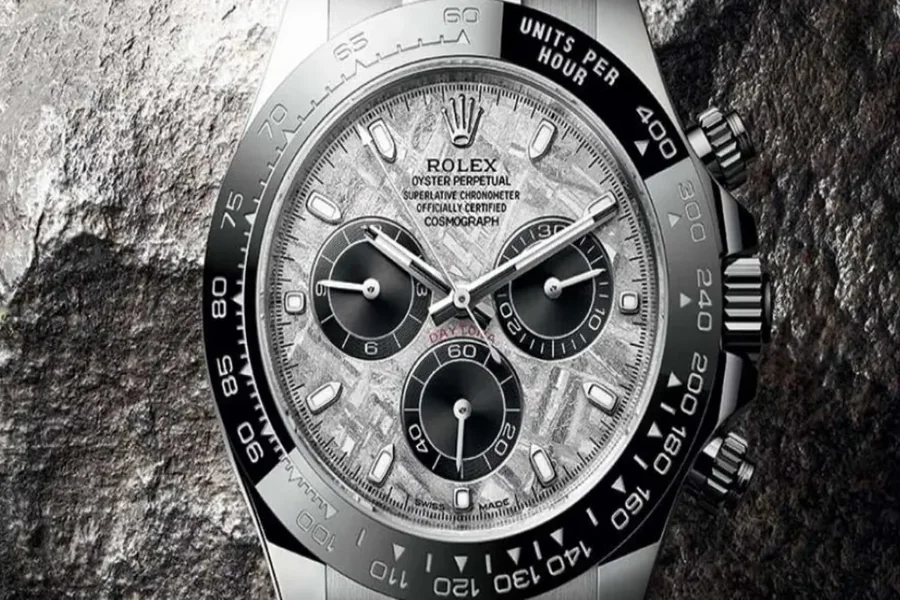
Did you know you can get a Rolex watch with a totally unique, crystalline pattern cut from a 4.5 billion year old chunk of space rock? If you weren’t aware, the luxury watch maker has done exactly that over several releases from the past two decades. As you might expect, these chunks of meteorite are very rare and the watches even more so. But what do you need to know about them?
This article will look at the cosmic history of these incredible timepieces, what exactly goes into making them so special and how much you’ll be looking at spending if you want one on the market today. This is everything you need to know about the incredible Rolex Meteorite watches.
What is a Meteorite Dial – and Why are They So Special?
The Gibeon Meteorite landed in Namibia around 5000 to 10,000 years ago. Although it had been around in space for a long time before that – most likely billions of years before Earth even existed. The 26 ton space rock broke up over a 240 square mile area of African desert and has since been adapted for use in various human materials.
Discover Rolex Meteorite models now and see what all the hype is about with these truly one-of-a-kind watches. The authentic meteorite material gives a unique texture and depth, ideal for anyone who wants to wear something completely out of the ordinary.
Most recently, chunks of the meteorite have been sliced apart to reveal fine Widmanstätten patterns which is a tightly-packed crystalline structure only found in space rocks. Naturally, this makes the pieces of this meteorite very rare and valuable for both aesthetic and cosmological reasons. Rolex use a thin sliver cross section slice of this meteorite as the backing dial for several different watch releases under the Meteorite name.
The Crazy Science Behind the Unique Pattern
The intricate crystallization process behind the unique pattern cannot be replicated in a laboratory. It only occurs when kamacite and taenite in the meteorite cool slowly over hundreds of thousands of years during its journey across the space. The patterns can be replicated visually, but they only naturally form in space rocks sailing across the endless void between stars.
Once the cross section pattern is sliced off and put into the watch dials, Rolex uses rhodium plates and an acid wash to bring out the inherent brightness in the metal sheet and also preserve it for, well, all time.
Interestingly, the Namibian government has now protected the remaining pieces of the Gibeon Meteorite. So as well as being exceedingly rare on the market, very few new pieces will be joining the existing ones. Rolex can continue to make Meteorite watches for a while yet, as they only need thin slivers for each piece and they have significant chunks in storage that they purchased before the Meteorite became protected. However, no-one outside of Rolex knows exactly how much they have – so every collection could be the last.
Rolex and Meteorites – A Brief History
Swiss watchmaker Rolex first began adding slices of the Gibeon meteorite to its watches in the early 2000s. The following collections have since featured dials backed by the incredible material:
- Daytona
- Day-Date
- Datejust
- Pearlmaster
- GMT Master II
The Day-Date and GMT Master II still occasionally see new Meteorite releases, but the Pearlmaster and the Datejust have since been continued. The Daytona collection last released a Meteorite version in 2023 but there are apparently no plans to release another. This makes Meteorite Rolexes even scarcer, and older models often sell for big money at auctions and on the resale market.
Rolex usually pairs the Meteorite dial material with white and rose gold or platinum, and quite often diamonds. The Daytona line Meteorite pieces are specifically sought after as the beautiful, cosmic dial backing contrasts anachronistically with the more modern, sporty and technical schematics of that collection.
The Collector’s Market – Retail and Auction Values
Understandably, given the rarity and iconoclastic appeal of owning a piece of unique space rock to wear about on your wrist – Rolex Meteorites will cost you a few dollars. For even a basic Daytona Meteorite you’ll be looking at minimum $80,000 on the resale market. The more expensive options, such as those that pair the meteorite facing with 24 CT white gold and cut diamonds, can be $150,000 plus.
The current production models aren’t quite that much, but they are still very expensive. A brand new Rolex GMT Master II or Day-Date Meteorite brought direct the watchmaker themselves will set you back around $30,000 to $60,000 depending on the exact model.
Platinum models are usually on the lower end of that scale, while high carat white gold options are the priciest. Most Meteorites, as some of the most prestigious in the Rolex collection, come with other top-of-the-line features such as advanced calibres and the famed Rolex Presidential bracelet known for its comfort and style.
Celebrities who have been snapped wearing Rolex Meteorites include Tom Cruise, Drake, Chris Hemsworth and Sylvester Stallone.