Where Wellness in New Zealand Operates as Infrastructure, Not an Activity
Across Auckland, Christchurch, Tauranga, Hamilton, and regional hubs, there are showrooms built around a range of spa pools. Not static displays. Heated units, running jets, active filtration, adjacent saunas, cold plunge setups.
Locations like Alpine Spas in East Tāmaki, Spa World in Christchurch, and Spa Store networks across the North Island operate this way. You walk in, sit in water, adjust controls, leave with a decision based on direct use.
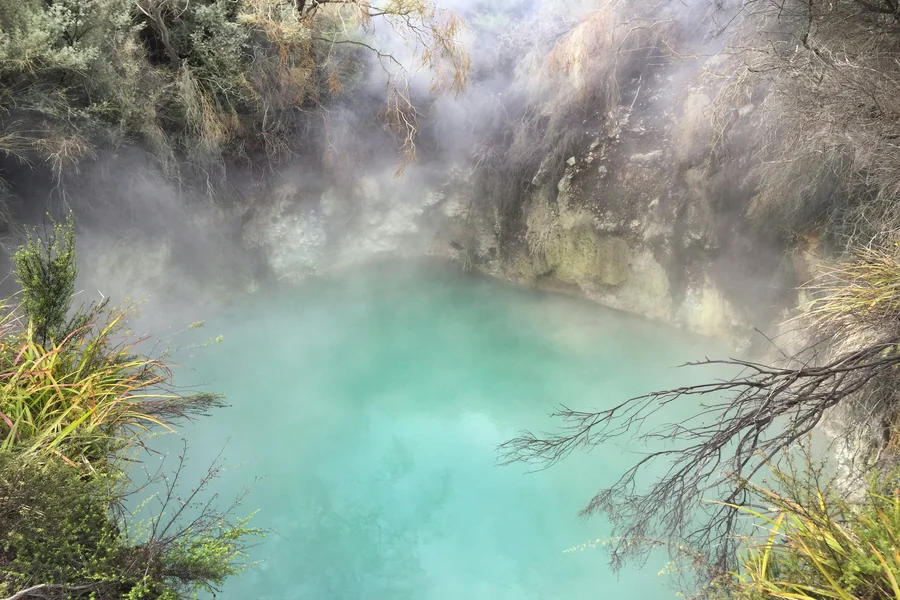
This matters because it mirrors what exists outside. Rotorua provides geothermal water from underground sources. Showrooms provide engineered equivalents. The transition between public and private use is direct. No interpretation layer. No branding narrative. Function moves from one setting to another without translation.
Rotorua: Thermal Activity as Daily Condition
Rotorua does not isolate geothermal features. They cut through the city grid. Steam vents appear in Kuirau Park, free to access, no entry fee, boiling mud pools beside footpaths. Sulphur Bay releases gas continuously along Lake Rotorua’s edge. The entire area operates on heat coming from below ground.
Facilities exist to channel that heat, not to create it.
Polynesian Spa and Controlled Mineral Separation
Polynesian Spa sits on two springs with different chemical profiles. Priest Spring produces acidic water. Rachel Spring produces alkaline water. The system keeps them separate.
Twenty-eight pools are distributed across temperature bands, roughly 36°C up to 41°C. The Pavilion Pools section uses acidic water, often associated with muscle relief. The Deluxe Lake Spa uses alkaline water, positioned with open views over Lake Rotorua.
Movement between pools is expected. Not optional. The layout forces circulation through different conditions, which creates the effect people describe as “recovery.” The mechanism is simple, heat variation and mineral exposure.
Hell’s Gate and Long-Term Use Without Modification
Hell’s Gate Geothermal Park operates with minimal adjustment. Mud pools remain active, releasing gas and heat continuously. The mud bathing process is direct, apply geothermal mud, allow it to dry, rinse in sulphur pools.
Recorded use extends back centuries. The site does not attempt to neutralize smell, texture, or temperature variance. The experience remains tied to the raw output of the geothermal system.
Beyond Rotorua: Water Without Containment
Leave Rotorua and the system opens. Fewer controlled environments. More direct access.
Kerosene Creek: Open Thermal Stream
Kerosene Creek sits off State Highway 5, accessed via a short gravel road. It is a naturally heated stream, surrounded by forest, with no built infrastructure.
Water temperature stays warm along most sections. A small waterfall provides localized pressure. People position themselves under it for direct force against shoulders and back.
No changing rooms. No segmentation. No staff. Usage depends on individual judgment. The site remains in constant use by locals and travelers.
Hot Water Beach: Temporary Construction by Users
Hot Water Beach operates on tidal timing. Geothermal heat rises through sand, but access requires low tide.
Visitors dig into the sand to create pools. Water fills from below. Too deep, the water overheats. Too shallow, it cools. Adjustment is continuous. The pool exists for a limited window, then disappears as the tide returns.
No permanent structure remains. The system resets twice daily.
Taupō: Mixed Thermal and Freshwater Systems
Taupō sits on a volcanic caldera filled with freshwater. It adds a different layer, contrast between hot and cold in immediate proximity.
Spa Thermal Park: Free Access With Minimal Control
Spa Thermal Park provides open access to geothermal streams feeding into the Waikato River. One side runs cold, the other hot.
Users move between temperature zones without barriers. No ticketing, no enclosed pools. The system remains partially managed for safety, but not commercialized.
Huka Falls: Water Volume as Physical Reference
Huka Falls channels the Waikato River through a narrow section, forcing large volumes of water through a compressed space.
Not a bathing site, but a reference point for understanding water movement in the region. Flow rate exceeds 200,000 liters per second. The force explains why geothermal mixing points nearby behave the way they do.
Coromandel Peninsula: Coastal and Thermal Overlap
The Coromandel region combines geothermal output with coastal access. Systems overlap rather than separate.
Cathedral Cove: Exposure Without Modification
Cathedral Cove provides open coastal access through a walking track. No construction beyond the path.
Swimming, walking, sitting. No layered services. The environment remains dominant.
New Chums Beach: Access With Constraint
New Chums Beach requires a 30–40 minute walk. No road access to the beach itself.
That constraint limits volume. The beach remains undeveloped. Use exists, but controlled by effort required to reach it.
Urban Integration: Residential Systems Mirror Natural Ones
The geothermal model does not stay in Rotorua. It translates into residential setups across the country.
Showrooms as Functional Testing Environments
In Auckland, Alpine Spas operates large showroom floors where spa pools run continuously. In Christchurch, Spa World maintains multiple active units alongside saunas and cold plunge systems.
These are not display models. Water is heated. Jets are active. Visitors sit inside, test pressure configurations, compare layouts.
This replaces abstract decision-making. Selection is based on physical response.
The phrase range of spa pools is literal here. Different sizes, jet systems, seating depths, thermal retention models. All operational.
Backyard Installations as Standard Layout
In Tauranga, Mount Maunganui, and Queenstown, residential properties commonly integrate spa pools into deck structures. Timber framing, wind shielding, partial roofing.
Positioning matters. Views are considered. In Queenstown, pools face Lake Wakatipu or surrounding ranges. In coastal regions, setups account for salt air exposure.
Saunas appear alongside pools. Barrel saunas in Wanaka, infrared units in Wellington homes. Cold plunge tubs placed adjacent to heated water.
Heat, cold, repeat. No instruction required.
Movement Systems: Terrain as Daily Use
Wellness in New Zealand extends beyond water. Movement is built into how cities and towns connect to terrain.
Queenstown: Immediate Access to Elevation
Queenstown sits between mountains and lake. Trails begin within residential zones.
Queenstown Hill Time Walk starts near housing areas. Ben Lomond Track extends further, gaining elevation quickly. No transport required to reach trailheads.
Movement integrates into daily routines. Not scheduled separately.
Wellington: Urban Layout With Embedded Tracks
Wellington includes the Town Belt, a network of green spaces encircling the city.
Walking and cycling routes connect neighborhoods through these areas. Movement occurs without entering main traffic systems.
Wind exposure adds resistance. Terrain adds variation. Physical activity becomes default.
Structured Facilities That Align With Natural Systems
Some sites combine built environments with geothermal input while maintaining alignment with the source.
Wai Ariki: Cultural and Thermal Integration
Wai Ariki Hot Springs and Spa integrates Māori design principles with geothermal systems.
Carved elements, spatial orientation, and water use follow cultural frameworks. Pools, saunas, and treatment areas operate within that structure.
This is not layered design. It is alignment between resource and identity.
Hanmer Springs: South Island Thermal Contrast
Hanmer Springs Thermal Pools and Spa sits in the South Island, using heated mineral water in a colder alpine setting.
Pools range across temperatures, supported by additional features like sulfur pools and rock pools. The contrast between external climate and water temperature becomes part of the system.
System Outcome: Reduced Friction Across Layers
New Zealand does not centralize wellness. It distributes it across geothermal sites, open-access water, residential installations, and urban movement systems.
Each layer removes a barrier.
Geothermal heat removes the need for artificial heating. Open access removes entry restrictions. Showrooms remove uncertainty in adoption. Trail networks remove planning friction.
The result is not a “wellness culture” in the usual sense. It is a set of systems that make certain behaviors easier than avoiding them.
No framing required.